
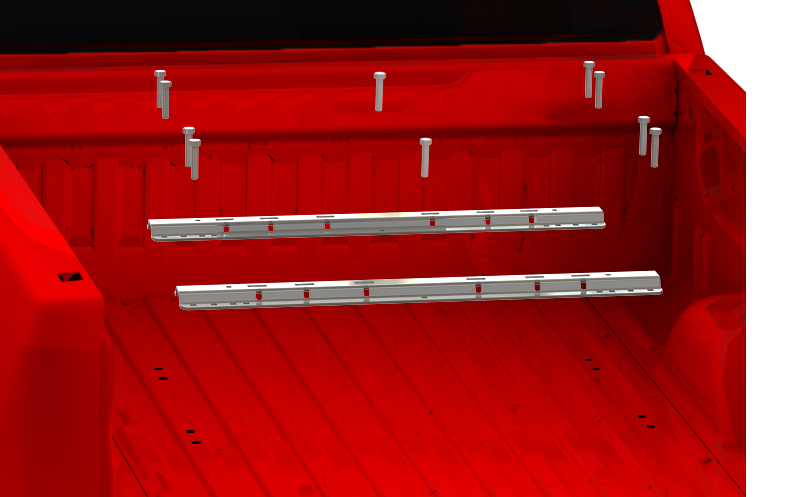
Industry Standard Rails, or ISR, are the most common way to mount a fifth wheel hitch in a truck bed. If your truck already has a rail-mounted system, there's a good chance it's the ISR pattern. That's good news: you can bolt a PullRite hitch onto rails that are already there. But the rails matter as much as the hitch sitting on top of them, and not all ISR rails are built the same. Here's how the system works, from under the bed up.
What "Industry Standard" Actually Means
ISR rails follow a standardized hole pattern. That pattern accepts fifth wheel hitches with tabbed (spade) feet that drop in and pin into place. Because the dimensions are standardized, a hitch built to the ISR pattern will fit ISR rails from most brands. That interchangeability is the whole point of the standard.
PullRite ISR rails meet that standard dimensionally. Where we part ways with the pack is in the steel, the strength rating, and how the system goes together. Our ISR rails can be bought on their own, but most customers buy them as a complete Mounting Kit: rails, the truck-specific mounting brackets, and all the hardware in one box.
Start Under the Bed: Custom Mounting Brackets
The brackets are the foundation. They bolt to the truck frame and carry the load down from the rails. Ours are built for a specific make and model, and in most cases they use existing holes in the frame, so there's usually no drilling.
If you do your own work, our brackets are straightforward to install. The catch with any under-bed job is that you don't always have a second set of hands, and the space under the bed is tight.
Hex Head Bolts, Not Carriage Bolts
Most manufacturers use carriage bolts to attach the base rails through the bed to the mounting bracket. A carriage bolt has a rounded head, so it can't be torqued from the top side. That leaves you fighting a torque wrench in the cramped space under the bed, working around brake lines, the gas tank, and everything else back there. In practice, a lot of those bed fasteners never get torqued to spec because you simply can't get a wrench on them properly.
We use hex head bolts instead. A hex head can be torqued from the top side of the bed, where you have room to work and can actually reach a proper torque value.
Nut Tab Technology
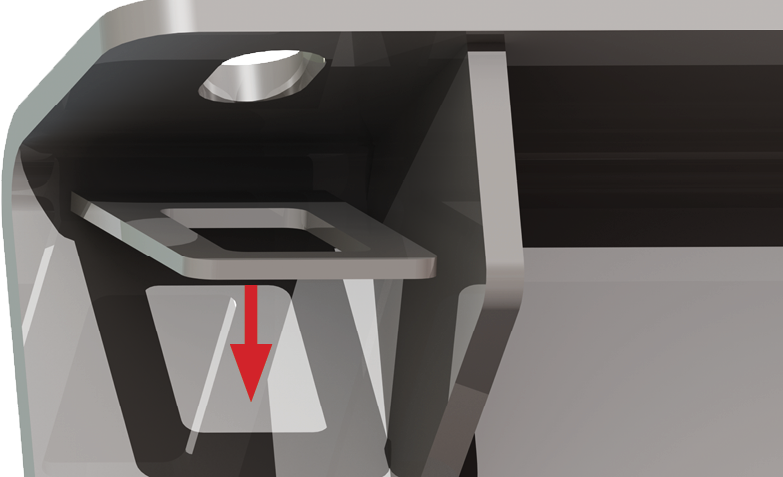
To make that top-side install possible, we use Nut Tabs. You gently bend a tab downward, slip in a serrated flange nut, then bend the tab back into place. The flange nut is now held captive and can't spin. From there, the rest of the job happens from the top of the bed: you use a pencil to slide the nut along the slotted hole in the top of the mounting bracket, lining it up through the hole in the bed and the base rail.
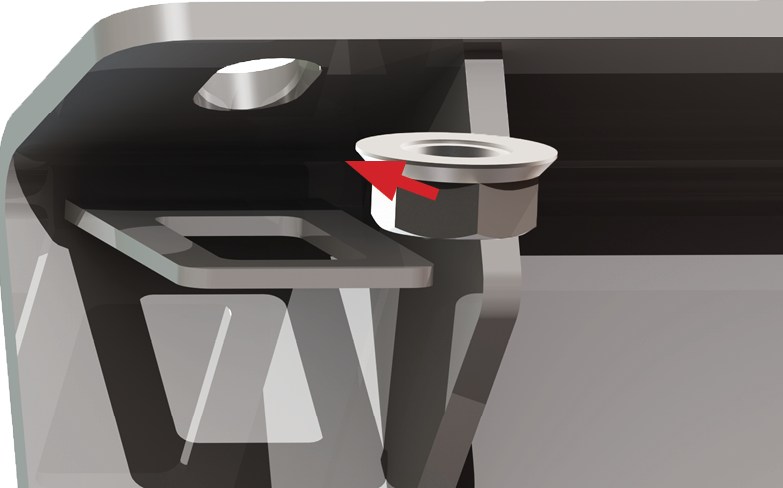
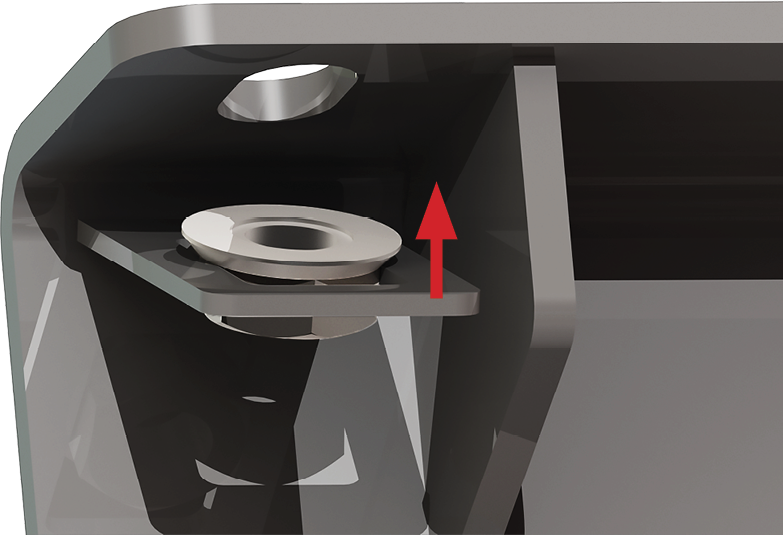
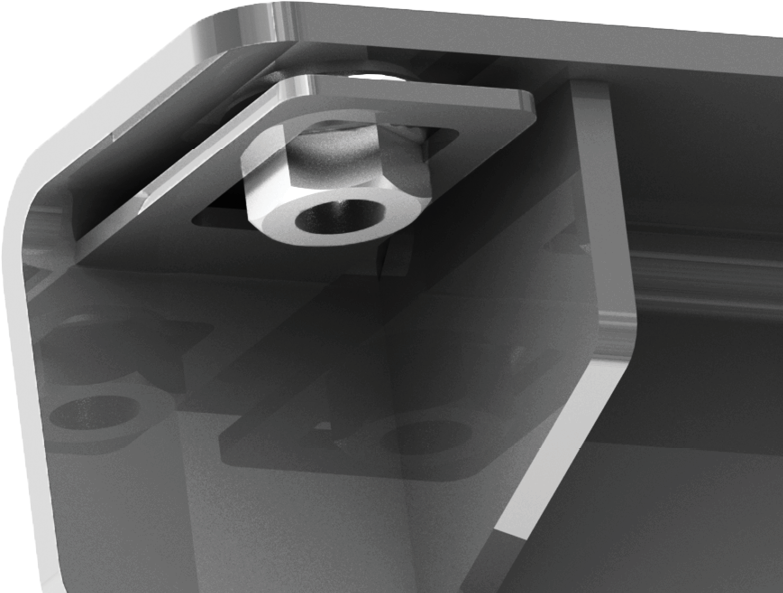
The result is a faster install and, more importantly, a better one, because the hardware can be torqued correctly from above. Even if you have a dealer do the work, a quicker install costs you less in labor.
Standard ISR Rails
Now the rails themselves. Look at a typical industry standard rail from the side and you'll see a "UFO" shape with sloping sides. That shape is built around the standardized hole pattern that lets the hitch's spade feet pin in.
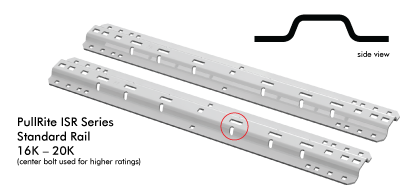
The weakness of that standard design is the holes. Every hole removes material and reduces tensile strength, and the worst spot is on the bed of the rail where the hitch pin hole and the spade foot hole sit closest together. That's where a rail is most likely to give.
PullRite Standard ISR Rails are rated between 16,000 and 20,000 pounds. To reach the higher end of that range, we use the center bolt locations on each rail to add holding strength.
We don't settle for "garden variety" steel. Our base rails use high-grade US steel, because we're RVers too and we care about what's holding a trailer behind us. Every product we build, base rails included, has to pass SAE J2638 testing, the industry strength standard for fifth wheel hitches.
Heavy Duty Rails
Here's the problem we built the Heavy Duty rails to solve. A lot of brands rate their hitches higher than the rails underneath them can actually handle, and when the rails aren't tested to the proper SAE standard, that mismatch is where failures start.
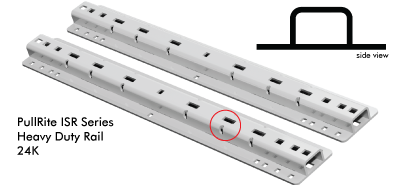
Our Heavy Duty rails use a reinforced "hat" shaped profile instead of the standard rail's sloping sides. The hat shape is much stronger. It also opens up a little more space between the hitch pin hole and the spade hole at the bend of the rail, exactly the spot where a standard rail is weakest. PullRite Heavy Duty rails are rated to 24,000 pounds.
Why the Weakest Part Sets Your Limit
This is the point dealers and manufacturers skip over, and it's the most important thing to understand. A towing system can only carry as much as its lowest-rated component.
Say you bought a 24,000-pound fifth wheel and a hitch rated for 24,000 pounds, but the base rails under it are only rated for 18,000. Your real, safe limit is 18,000 pounds. The big hitch number on the box doesn't change that. The rails do. Match your gross trailer weight (GTW) to the lowest rating in the chain, not the highest.
Tight Tolerances, Quiet Towing
How well a hitch's spade feet fit the rails affects how the rig feels on the road. We cut our rails to fit the tabbed feet of our hitches closely in the fore-to-aft direction. Less slop in that joint means less chucking and less noise while you tow.
About Removing and Reinstalling
ISR rails are a bolt-down system. They're not meant to be pulled out and put back in every time you want a clear bed for hauling. If a clean, open bed matters to you, that's why we built ISR SuperRails, which are part of the SuperRail family and address removal in a way standard bolt-down rails can't.
PullRite has been building American-made towing products since 1974. No matter which PullRite hitch sits on top — SuperGlide, Super 5th, or SuperLite — the rails are part of the system, and we build them to match.