
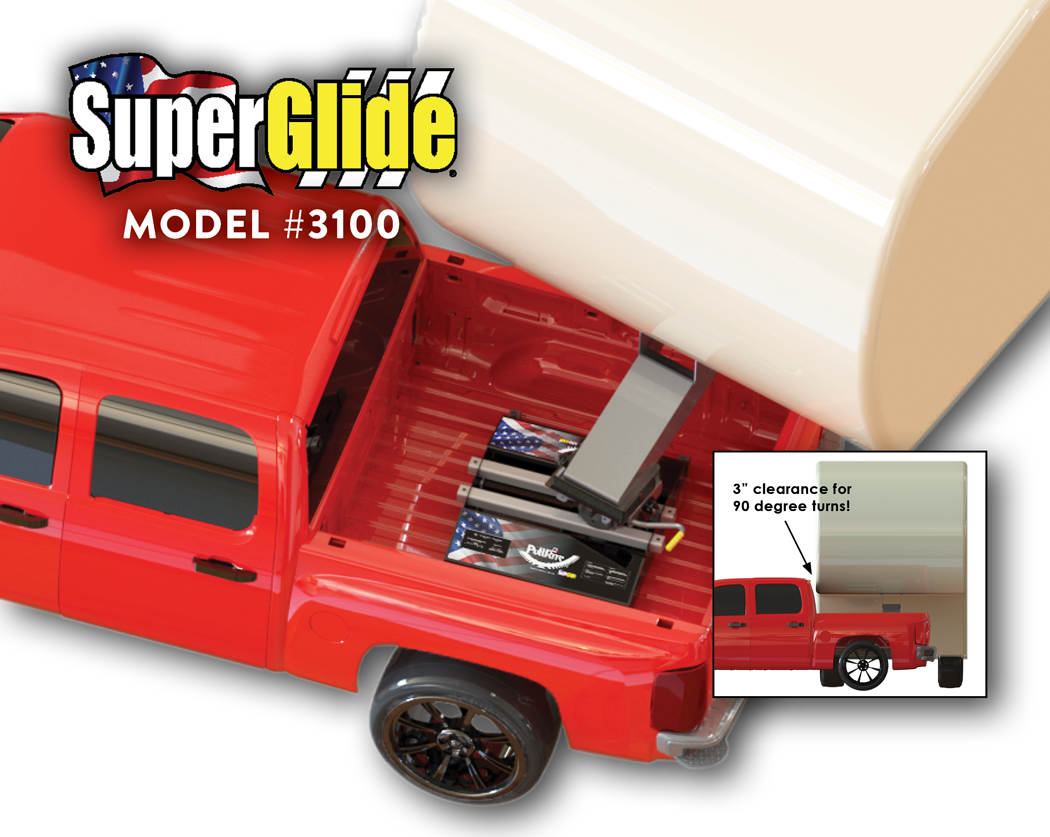
Most truck makers will tell you that you can't pull a fifth wheel with a 5½-foot short bed. They're right about almost every hitch on the market. They're wrong about one. The PullRite SuperGlide #3100 and #3200 are the only hitches of any brand built to give a short-bed crew cab the clearance it needs to turn without folding the trailer into the back of the cab. Here's the engineering behind that, and how to tell if your truck and trailer are a match.
Why the short-bed crew cab is a problem
When Ford launched the SuperCrew (a half-ton pickup with four full doors on a standard wheelbase), it took off. Ram, GM, and Toyota built their own versions, and the four-door short bed is now the most popular half-ton body style sold.
To fit four doors, the cab had to grow. But the wheelbase stayed the same, so the bed had to shrink. A longer cab on the same wheelbase means the distance from the back of the cab to the center of the rear axle gets a lot shorter. That distance is called cab-to-axle, and it's the number that decides whether a fifth wheel can turn.
A fifth wheel trailer is at least 96 inches wide. When you turn, half of that width (48 inches) swings toward the back of the cab. On a short-bed truck, the cab is much closer than 48 inches away. That's why the manufacturers say it can't be done. With a standard fixed hitch, they're correct.
The clearance math
You can do this math yourself. The formula is simple:
(cab-to-axle distance) − (half of trailer width) = cab clearance
Half of trailer width is 48 inches on a standard 96-inch fifth wheel. Here's how three Ford bed lengths compare:
- 8-foot bed: 56" cab-to-axle − 48" = 8" of clearance. More than enough. A fixed hitch turns freely.
- 6-foot bed: 40" cab-to-axle − 48" = −8". Short by 8 inches. It won't make a full 90-degree turn on a fixed hitch. Manageable if you watch your tight turns and run a slider, manual or automatic.
- 5½-foot bed: 28¼" cab-to-axle − 48" = −19¾". Short by nearly 20 inches. This is the problem truck.
That 8-foot bed has clearance to spare. The 5½-foot bed is short by a wide margin, and no fixed hitch comes close to covering it.
How much travel you actually need
Closing 19¾ inches of negative clearance isn't quite enough on its own. Real roads aren't flat. You need a few more inches to account for road contours, dips, and grade changes where the truck and trailer pitch toward each other. Add about 3 inches. That brings the real distance the hitch has to move the trailer back to 22¾ inches.
Now compare that to what's out there:
- Manual sliding hitches: none travel more than 12 inches.
- Other SuperGlide models: none travel more than 18 inches.
- SuperGlide #3100 and #3200: travel the full 22¾ inches.
That's the whole story. The #3100 and #3200 are the only hitches of any type or brand that move the trailer back the exact distance a 5½-foot bed requires. Every other option falls short.
How the SuperGlide moves the trailer for you
The SuperGlide isn't a manual slider you have to stop and unlatch. It uses cam action tied to your truck's movement. As you turn, the hitch automatically slides the trailer rearward to clear the cab, then returns it to center as you straighten out. You don't push a lever or get out of the truck.
That automatic turning depends on one required part: a Capture Plate. Every SuperGlide model needs a Capture Plate installed on the trailer's king pin box to engage the cam action. Without it, the hitch can't do its job, so plan on the Capture Plate as part of any SuperGlide setup.
Your trailer has to qualify too
The right hitch is only half of it. Even with a #3100 or #3200, not every trailer works on a short-bed truck. Two things matter.
Trailer width
Your trailer can't be wider than 96 inches. The 48-inch swing figure in the math above assumes a standard 96-inch fifth wheel. Anything wider changes the geometry and may not clear.
King pin position and the nose cap
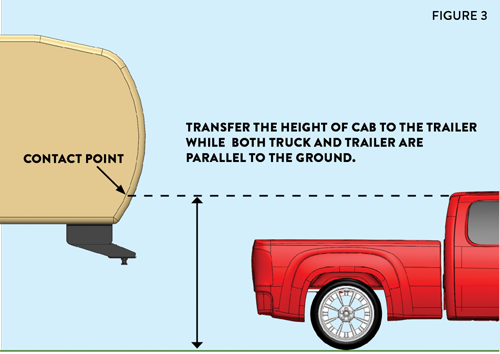
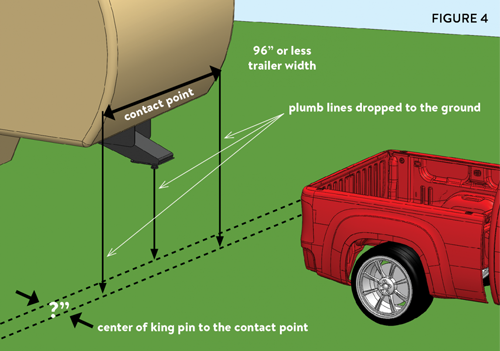
The other factor is how far your king pin sits ahead of the point where the trailer would first touch the cab. Call that the contact point. The farther your king pin is forward of the contact point, the better the trailer fits a short-bed truck.
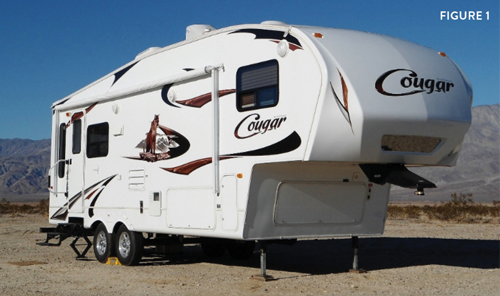
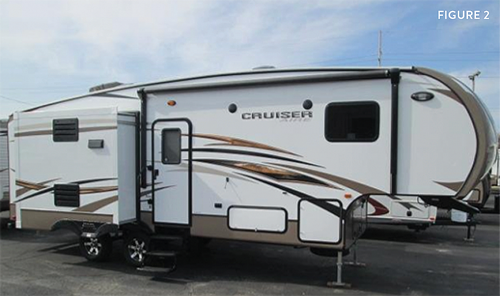
Many modern trailers have contoured nose caps. The nose may overhang the king pin in the middle, but the corners are pulled back behind the king pin. Those corners are what reach the cab first. A trailer with square, full corners contacts the cab much sooner than one with the corners removed and contoured.
One thing works in your favor: only the part of the nose cap below the cab line matters. Anything above the cab line is taller than the truck cab and will never touch it, so it doesn't count against your clearance.
Required king pin distance by truck make
Each truck make has a slightly different cab-to-axle distance, so each requires a different amount of king pin clearance ahead of the contact point. Find your make below. The second number is how far ahead of the contact point your king pin needs to be:
- Ford — 28¼" cab-to-axle — king pin must be 10" ahead of the contact point.
- Ram — 28¾" cab-to-axle — king pin must be 8" ahead of the contact point.
- GM — 32¾" cab-to-axle — 0" required.
- Toyota — 32¾" cab-to-axle — 0" required.
Ford and Ram have the shortest cab-to-axle distances, so they demand the most fore-and-aft room between the contact point and the king pin. GM and Toyota carry a little more cab-to-axle distance, so they require none. Measure your trailer before you buy.
The short version
A 5½-foot short-bed crew cab can tow a fifth wheel, but the margins are tight and the rules are real:
- Use a SuperGlide #3100 or #3200. Nothing else travels far enough.
- Add the required Capture Plate for automatic turning.
- Keep your trailer at or under 96 inches wide.
- Check your king pin position against the requirement for your truck make.
PullRite has been building fifth wheel hitches in the USA since 1974, and the SuperGlide is the reason short-bed owners have a real answer instead of a flat no. If you're not sure your truck and trailer pair up, call our Customer Service team at (800) 443-2307 for fit and compatibility help before you buy.